What is RAG ?

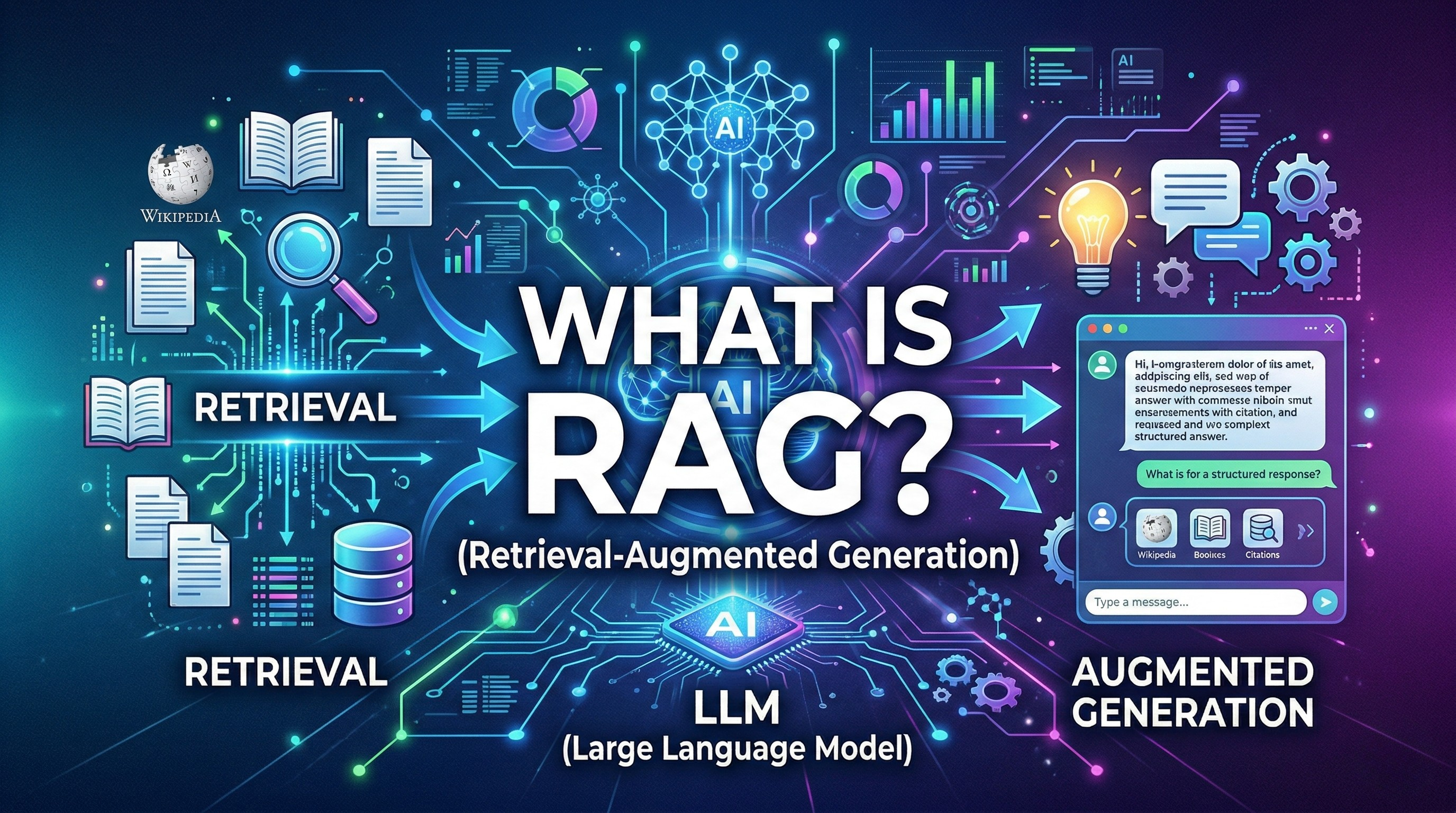
What Is RAG? A Complete Guide to Retrieval-Augmented Generation
How the architecture behind modern AI applications actually works
Introduction
Large language models like GPT-4, Claude, and Gemini are impressive. They can write code, summarize documents, and answer complex questions. But they have a fundamental limitation: they only know what they were trained on, and that training data has a cutoff date.
Ask an LLM about your company's internal policies, last quarter's sales data, or a research paper published last week, and it will either make something up or tell you it does not know. This is not a minor inconvenience. For most real-world applications, the information users need is private, recent, or domain-specific, exactly the kind of information the model was never trained on.
Retrieval-Augmented Generation (RAG) solves this problem. Instead of relying solely on what the model memorized during training, RAG retrieves relevant information from your own data and feeds it to the model at query time. The model then generates its answer based on that retrieved context.
RAG has become the standard architecture for building AI applications that need to work with real, specific, up-to-date information. This article explains how it works, why it matters, and what to get right when building one.
The Problem RAG Solves
LLMs have two specific failure modes that matter in production:
Hallucination. When an LLM does not have the information needed to answer a question, it often generates a plausible-sounding but completely fabricated response. Ask it about a company policy it has never seen and it will confidently produce one that does not exist. In customer-facing applications, this is not just unhelpful. It is a liability.
Stale knowledge. An LLM's training data is frozen at a point in time. It cannot know about product changes shipped last month, regulatory updates from last week, or a support ticket filed this morning. For any application where information changes, the model is always behind.
The brute force solution would be to retrain or fine-tune the model on your data every time something changes. This is expensive (thousands to hundreds of thousands of dollars per training run), slow (days to weeks), and impractical for information that updates frequently.
RAG takes a different approach: keep the model as-is, but give it the right information at the moment it needs it.
How RAG Works
The RAG architecture has two phases that happen in sequence every time a user asks a question.
Phase 1: Retrieval
When a user submits a query, the system first searches a knowledge base to find the most relevant pieces of information. This knowledge base is your data: product documentation, support articles, internal wikis, PDF reports, database records, or anything else you want the AI to be able to reference.
Here is what happens step by step:
1. Your data is pre-processed and indexed. Before the system can search anything, your documents are split into smaller chunks (typically a few hundred words each), converted into vector embeddings using a model like OpenAI's text-embedding-3-small, and stored in a vector database. This is a one-time setup step (with updates as your data changes).
2. The user's query is converted into a vector. The same embedding model that encoded your documents also encodes the user's question into a vector.
3. The system searches for similar vectors. The vector database finds the document chunks whose vectors are closest to the query vector. "Closest" here means semantically similar, not just matching on keywords. A query about "how to cancel my subscription" will match a document titled "Account Cancellation Policy" even though the exact words differ.
4. The top results are retrieved. Typically 3 to 10 of the most relevant chunks are pulled from the database. These become the "context" for the next phase.
This retrieval step is where vector search performance is critical. At scale, your system might be handling thousands of queries per second, each requiring a vector similarity search across millions of document chunks. This is why fast indexing algorithms like HNSW matter, and why the choice of vector database directly affects whether your RAG system can serve real-time traffic.
Phase 2: Generation
The retrieved document chunks are inserted into the prompt alongside the user's question, and the LLM generates a response grounded in that context.
A simplified version of what the prompt looks like:
Context:
[Document chunk 1: "To cancel your subscription, go to Settings > Account > Cancel Plan..."]
[Document chunk 2: "Cancellations take effect at the end of the current billing cycle..."]
[Document chunk 3: "Refunds are available within 14 days of purchase..."]

User question: "How do I cancel my subscription and will I get a refund?"

Answer the question using only the context provided above.
The LLM reads the retrieved context and generates an answer that directly references the actual information from your knowledge base. Instead of guessing or hallucinating, it is working from real data.
The result: The user gets an accurate, grounded answer that reflects your actual documentation, policies, or data, not something the model invented.
Why RAG Has Become the Default Architecture
RAG is not just one option among many. It has become the standard way to build production AI applications for several practical reasons.
It works with any LLM. RAG is model-agnostic. You can use GPT-4, Claude, Gemini, Llama, Mistral, or any other model. If you switch models later, your retrieval infrastructure stays the same.
Your data stays current without retraining. When your product documentation changes, you update the vector database. The next query automatically retrieves the new information. No retraining, no fine-tuning, no waiting.
It dramatically reduces hallucination. By grounding the model's response in retrieved evidence, RAG gives the model something concrete to reference. You can further reduce hallucination by instructing the model to only answer based on the provided context and to say "I don't know" when the context is insufficient.
It scales to large knowledge bases. A well-built RAG system can search across millions of document chunks in single-digit milliseconds using vector indexes like HNSW. The knowledge base can grow continuously without degrading query performance.
It is cheaper than fine-tuning. Fine-tuning a large model costs real money and engineering time, and it needs to be repeated as data changes. RAG requires only vector storage and search infrastructure, which is a fraction of the cost.
The Traffic Challenge: Why Infrastructure Matters
Here is something that catches many teams off guard. In a RAG system, the vector search layer handles far more traffic than you might expect.
Consider a customer support chatbot powered by RAG. Every single message from every single user triggers at least one vector search query. If your chatbot handles 10,000 conversations per day and each conversation has 5 back-and-forth exchanges, that is 50,000 vector searches per day. Scale to a popular product and you are looking at millions of queries per week, all requiring low-latency responses because users are waiting in real time.
This is fundamentally different from traditional database workloads where reads might be cached or batched. In RAG, every query is unique (because every user question is different), every query needs a fresh similarity search, and every query is latency-sensitive.
This is why your choice of vector database is not an afterthought. It is a core infrastructure decision. You need a system that can handle high query throughput at consistently low latency, without costs scaling linearly with traffic. Vector databases like Endee are built specifically for this kind of workload, offering high-performance vector search with cost efficiency at scale.
What Makes a RAG System Good or Bad
Building a basic RAG prototype is easy. Building one that works well in production is harder. Here is what separates good RAG systems from bad ones.
Retrieval Quality Is Everything
If the retrieval step returns irrelevant chunks, the LLM will generate a bad answer no matter how capable the model is. Garbage in, garbage out. The single most impactful thing you can do to improve a RAG system is improve retrieval quality.
This means choosing the right embedding model for your domain, tuning your chunking strategy (chunk size, overlap, and boundaries), and using hybrid search (combining dense vector search with keyword-based BM25 search) to handle both semantic and exact-match queries.
Chunking Strategy Matters More Than You Think
How you split your documents into chunks directly affects what the retrieval step can find. Chunks that are too small lose context. Chunks that are too large dilute the relevant information with noise. There is no universal best chunk size, but 200 to 500 words with some overlap between chunks is a reasonable starting point for most use cases.
Not All Queries Need Retrieval
A smart RAG system recognizes when retrieval is unnecessary. If a user asks "what is 15% of 200," there is no need to search the knowledge base. Adding a routing layer that decides whether to retrieve or let the model answer directly improves both speed and quality.
Evaluation Is Non-Negotiable
You need a systematic way to measure whether your RAG system is returning good results. This means building an evaluation set: a collection of real questions paired with the correct answers and the documents that should be retrieved. Measure retrieval recall (did we find the right documents?) and answer quality (did the model produce the correct response?) separately, because a failure in either step requires a different fix.
RAG Architecture at a Glance
User Question
      |
      v
 Embed Query (vector embedding model)
      |
      v
 Vector Search (find similar document chunks)
      |
      v
 Retrieve Top-K Chunks
      |
      v
 Build Prompt (question + retrieved context)
      |
      v
 LLM Generates Answer (grounded in retrieved context)
      |
      v
 Response to User
Common Mistakes
Skipping hybrid search. Dense vectors miss exact terms. Sparse search (BM25) misses paraphrases. Using both catches queries that either one alone would fail on.
Ignoring retrieval evaluation. Teams spend weeks tuning the LLM prompt while their retrieval step returns the wrong documents. Always measure retrieval quality first.
Treating vector search as a commodity. At production traffic levels, vector search latency and throughput become critical. A system that works fine at 100 queries per minute may fall over at 10,000.
Stuffing too much context into the prompt. More retrieved chunks is not always better. Including irrelevant chunks confuses the model and increases cost (LLM pricing is per-token). Retrieve more, then re-rank aggressively before passing context to the model.
Never updating the knowledge base. A RAG system is only as good as its data. If your documentation changes but your vector database still contains the old version, users get outdated answers. Build a pipeline that keeps the index current.
Conclusion
RAG has become the standard architecture for building AI applications that need to reference real, specific, and up-to-date information. It combines the language understanding of LLMs with the precision of information retrieval, giving users accurate answers grounded in your actual data.
The architecture is conceptually simple: retrieve relevant context, then generate a response. But the details matter. Retrieval quality determines answer quality. Chunking strategy determines what retrieval can find. And at production scale, the vector search layer needs to handle massive, latency-sensitive traffic without breaking a sweat.
Get the retrieval layer right, and the rest of the system falls into place.