What Is a Vector Database? The Complete Guide for 2026

What Is a Vector Database? The Complete Guide for 2026
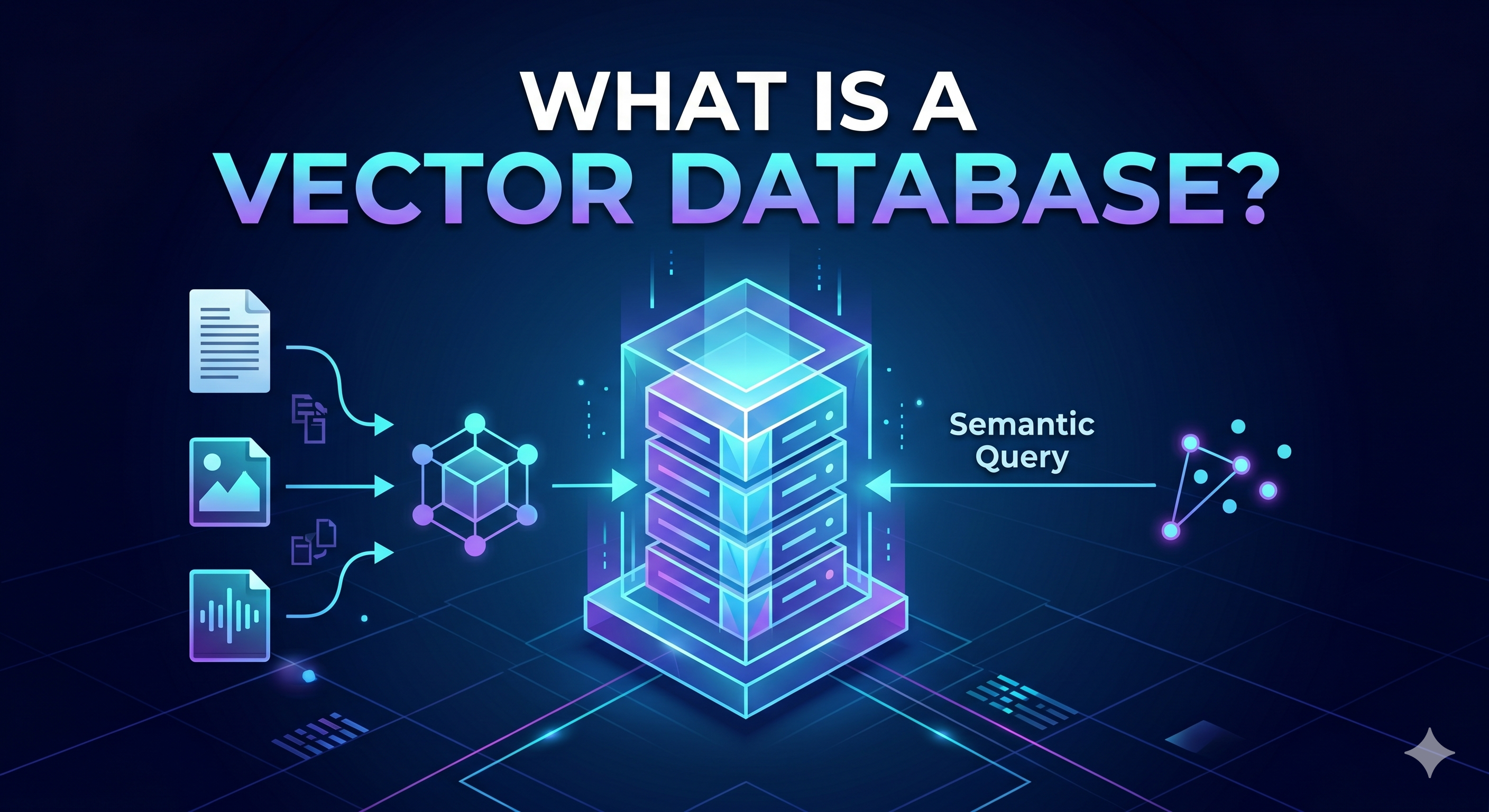
The short answer: A vector database is a specialised data store built to index, store, and search high-dimensional numerical representations called vector embeddings using similarity search rather than exact-match queries. Unlike traditional databases that find records by equality, a vector database finds records that are semantically closest to a query -- powering AI applications like semantic search, RAG pipelines, recommendation engines, and multimodal retrieval at scale.
The Problem Traditional Databases Cannot Solve
Picture a customer typing "lightweight running shoes for flat feet" into an e-commerce search bar. A traditional database executes a keyword match and returns only products whose titles contain exactly those words. It does not know that "neutral trainers for overpronation" is semantically the same thing. It cannot understand meaning.
Now picture a developer building an AI assistant for a legal team. The assistant needs to retrieve the three most relevant case documents from a corpus of ten million records before generating an answer. A relational database with a LIKE query will miss synonyms, fail on paraphrases, and slow to a crawl at that scale.
This is the fundamental gap that vector databases solve: the ability to search by semantic meaning, visual similarity, or contextual relevance, not just by exact string or numeric match.
Traditional databases ask "Does this record match?" Vector databases ask "Which records are most similar to this?" That shift in question is what makes vector databases the backbone of modern AI applications.
What Is a Vector Embedding?
Before defining a vector database, you need to understand what it stores.
A vector embedding is a list of floating-point numbers that captures the semantic meaning or salient features of a piece of data. Think of it as a unique numerical fingerprint for any piece of content -- a sentence, a product image, an audio clip, or a video frame.
Machine learning models such as OpenAI's text-embedding-3-large, Google's text-gecko, or open-source models like all-MiniLM-L6-v2 convert raw data into these embeddings. The key property is that similar inputs produce numerically similar outputs.
Here is a simplified illustration:
| Input | Embedding (truncated for readability) |
|---|---|
| "cat" | [0.21, -0.87, 0.44, ..., 0.09] |
| "kitten" | [0.19, -0.84, 0.47, ..., 0.11] |
| "automobile" | [-0.61, 0.33, -0.12, ..., 0.77] |
"Cat" and "kitten" produce embeddings that sit very close together in this high-dimensional space. "Automobile" sits far away. That geometric proximity is the meaning. The closer two vectors are, the more semantically related the content they represent.
Similarity between two vectors is typically measured using:
- Cosine similarity: the angle between two vectors, most common for text
- Euclidean (L2) distance: the straight-line distance between two points, common for images
- Dot product: directional alignment, faster for certain model architectures
The number of dimensions in a vector is called the embedding dimension. This typically ranges from 384 to 3072 depending on the model. Higher dimensionality captures richer semantic nuance, at the cost of more memory and compute.
What Is a Vector Database?
A vector database is a database purpose-built to do three things well:
- Store high-dimensional vectors alongside their metadata (tags, categories, timestamps, IDs)
- Index those vectors using specialised data structures optimised for high-dimensional space
- Search using Approximate Nearest Neighbor (ANN) algorithms to return the k most similar vectors to a query, in milliseconds, even across billions of records
It is the memory layer of modern AI systems: the persistent, searchable store that lets your AI retrieve the right knowledge at query time rather than hallucinating an answer from its training data alone.
Why "approximate" and not exact? Exact nearest-neighbor search over billions of high-dimensional vectors requires comparing every single stored vector against the query. That is computationally intractable at any real production scale. ANN algorithms make a controlled trade-off: they sacrifice a tiny fraction of recall (finding, say, 985 of the true top 1000 results instead of all 1000) in exchange for search speeds that are orders of magnitude faster. For virtually every real-world AI application, this trade-off is completely acceptable.
How a Vector Database Works -- Step by Step
Step 1: Ingest and Embed
Raw data -- documents, product images, user behaviour logs, audio files -- is passed through an embedding model. The model outputs a dense vector for each data object. This vector, along with structured metadata like price, category, timestamp, or user ID, is the unit of storage.
Input:  "Endee is an ultra high-performance vector database."
Model:  text-embedding-3-large (OpenAI) or all-MiniLM-L6-v2 (open-source)
Output: [0.034, -0.211, 0.098, ..., 0.761]  <- 1536-dimensional vector
The embedding model is chosen once and kept consistent across both the data ingestion pipeline and the query pipeline. This matters: if you embed your documents with one model and your queries with another, the vector spaces will not align and search results will be meaningless.
Step 2: Build the Index
Simply storing vectors in a list and comparing every query against every vector -- known as brute-force or flat search -- is accurate but does not scale. A vector database builds an index at write time: a specialised data structure that organises vectors to make repeated querying orders of magnitude faster. The index is rebuilt or updated as new data arrives.
Step 3: Query with a Vector
At query time, the user's input (a search phrase, an uploaded image, a clicked product) is converted into a query vector using the same embedding model. The vector database then searches its index for the k most similar stored vectors.
# Pseudocode illustrating the query pattern
query_vector = embed("lightweight running shoes flat feet")

results = vector_db.query(
    collection="product_catalog",
    query_vector=query_vector,
    top_k=10,
    filters={"category": "footwear", "in_stock": True}
)
Step 4: Apply Metadata Filters
Real-world queries almost always combine vector similarity with metadata filters: price under a threshold, items in stock, documents belonging to a specific department, records within a date range. A well-designed vector database applies these filters efficiently alongside similarity search, not as a slow sequential post-processing step.
Step 5: Return Ranked Results
The database returns the top-k most similar results, ranked by their similarity score, along with their metadata and original payload. The calling application -- whether an LLM, a search UI, or a recommendation engine -- consumes these results and acts on them.
Key Indexing Algorithms: HNSW, IVF, and PQ
The indexing algorithm is the performance engine of a vector database. Three approaches dominate the industry, each with different trade-offs across speed, memory usage, and recall.
HNSW: Hierarchical Navigable Small World
HNSW is currently the gold standard for high-recall, low-latency ANN search. It works by building a multi-layer proximity graph:
- Upper layers are sparse and contain only a small fraction of all vectors. They act as an express highway, allowing the search algorithm to traverse large distances across the embedding space in very few steps.
- Lower layers are progressively denser. The algorithm descends through them, refining its search toward the true nearest neighbors.
- Layer 0 contains all vectors, and the final precision search happens here.
When a query arrives, the algorithm enters at the top layer, greedily navigates toward the query vector layer by layer, and arrives at a tight set of candidates at the bottom. The result is near-logarithmic search complexity: as your dataset grows from one million to one billion vectors, query time grows very slowly rather than linearly.
When to use HNSW: Any production workload where you need consistently fast query times and high recall. It is the default choice for most vector databases.
Trade-off: HNSW keeps the entire index in RAM for optimal performance. Memory usage scales with dataset size.
IVF: Inverted File Index
IVF partitions the entire vector space into clusters using k-means. Each vector is assigned to its nearest cluster centroid. At query time, the algorithm identifies the most promising clusters and searches only within them, drastically reducing the number of comparisons.
When to use IVF: Very large datasets where memory is constrained, or when you are willing to tune the number of clusters searched (nprobe) to control the speed vs. recall trade-off.
Trade-off: Lower recall than HNSW unless carefully tuned. Requires an upfront clustering step when building the index.
PQ: Product Quantization
PQ compresses vectors by splitting each high-dimensional vector into smaller sub-vectors and quantizing each sub-vector independently into a compact code. A 768-dimensional float32 vector that would normally take about 3 KB can be compressed to 32 bytes or fewer.
When to use PQ: Billion-scale datasets where memory is a hard constraint. PQ is almost always combined with IVF (called IVF-PQ) to get both spatial partitioning and compression.
Trade-off: Lossy compression introduces some recall degradation. Re-ranking retrieved candidates against the original vectors is often necessary to recover precision.
Vector Database vs Traditional Database
| Dimension | Relational DB (PostgreSQL, MySQL) | NoSQL DB (MongoDB, Cassandra) | Vector Database (Endee, Pinecone, Qdrant) |
|---|---|---|---|
| Primary data model | Tables, rows, columns | Documents, key-value, graphs | High-dimensional vectors and metadata |
| Query type | Exact match, range, joins | Exact match, aggregation | Similarity search, hybrid, semantic |
| Search basis | Boolean logic and equality | Hash or key lookup | Geometric proximity in vector space |
| Unstructured data | Poor -- requires preprocessing | Moderate | Native: text, images, audio, video |
| AI and RAG pipelines | Not designed for this | Limited | Purpose-built |
| Typical use case | Financial records, user accounts | Session data, logs, flexible schemas | Semantic search, recommendations, RAG |
A word of clarification: hybrid solutions like PostgreSQL's pgvector extension or MongoDB Atlas Vector Search add vector capabilities to general-purpose databases. These work well for smaller workloads and teams that want to avoid a separate system. For high-throughput production AI applications, purpose-built vector databases offer significantly better performance, more indexing options, and more granular operational controls.
Top Use Cases in 2026
Vector databases are now foundational infrastructure across a wide range of industries and applications.
1. Retrieval-Augmented Generation (RAG)
RAG is the dominant architecture for grounding LLM responses in private, current, or domain-specific knowledge. The problem it solves is straightforward: an LLM trained up to a certain date cannot know about your internal documents, your product catalogue, or events that happened last week. Without grounding, it hallucinates.
In a RAG system, the vector database acts as the external memory. The pipeline works like this:
- Your private documents are chunked, embedded, and stored in the vector database.
- When a user asks a question, that question is embedded into a vector.
- The vector database retrieves the top-k most relevant document chunks.
- Those chunks are passed to the LLM as context alongside the original question.
- The LLM generates a response grounded in your actual data, not its training data.
RAG now powers the majority of enterprise AI implementations -- from customer support bots and internal knowledge bases to legal research assistants and medical documentation search.
2. Semantic Search and Enterprise Search
Keyword search has a fundamental flaw: it only finds documents that contain the exact words in the query. Someone searching for "machine downtime analysis" might miss a report titled "equipment failure diagnostics" even though both documents discuss the same topic.
Semantic search powered by vector embeddings finds results based on meaning, not character matches. A query retrieves documents that are conceptually relevant even when the vocabulary differs, even across languages.
This is particularly valuable in enterprises with large internal knowledge bases -- engineering documentation, legal contracts, HR policies, support ticket histories -- where terminology is inconsistent and exact keyword matching produces frustrating results.
3. Recommendation Engines
E-commerce platforms, streaming services, and content networks use vector search to surface "similar items" recommendations. Each product, article, song, or video is represented as a vector. A user's preferences or behaviour history is also encoded as a vector. The system retrieves the items nearest to the user's preference vector in real time.
This approach is more flexible and more semantically rich than traditional collaborative filtering or rule-based systems. It handles cold-start problems better, works across modalities (text descriptions alongside product images), and scales naturally.
4. Image and Multimodal Search
Multimodal embedding models like CLIP, BLIP-2, or Gemini's vision models embed images and text into the same vector space. This enables powerful cross-modal queries:
- "Find product images similar to this uploaded photo"
- "Show me documents related to this diagram"
- "Retrieve all frames from this video library that show a person in a red jacket"
In retail, this powers visual search and "shop the look" features. In manufacturing and healthcare, it enables diagnostic image retrieval based on visual similarity to reference cases.
5. Anomaly Detection and Fraud Prevention
Normal behaviour clusters tightly in vector space. When a transaction, network event, or sensor reading is anomalous, its embedding lands far from the cluster of known-normal data points. This geometric property makes vector databases a natural fit for anomaly detection.
Financial services companies use this to flag unusual transaction patterns. Manufacturers use it to detect defect signatures in sensor data before equipment fails. Cybersecurity teams use it to identify novel attack patterns that signature-based systems miss entirely.
6. Drug Discovery and Scientific Research
Molecular fingerprints -- numerical representations of chemical structures -- can be encoded as vectors. Researchers can query a library of millions of candidate compounds to find molecules with similar binding properties, structural motifs, or predicted biological activity. This dramatically accelerates the early screening phase of drug discovery.
The same principle applies to genomics (finding similar gene sequences), materials science (identifying compounds with similar properties), and academic literature search (finding papers relevant to a research question regardless of which specific terms they use).
7. Customer Support and Knowledge Management
Support platforms use vector search to match incoming customer queries against resolved tickets, help articles, and documentation. When a user submits a new support request, the system retrieves the most similar past cases and suggested resolutions, dramatically reducing time-to-resolution.
This also powers agent assist tools: as a support agent is typing a response, the system is simultaneously retrieving relevant policy documents, past interactions with the same customer, and similar resolved cases -- surfacing context the agent would otherwise have to hunt for manually.
What to Look for in a Vector Database
Choosing a vector database for a production workload involves evaluating several dimensions. The right choice depends on your specific data, query patterns, team, and infrastructure constraints.
Performance: Latency, Throughput, and Recall
These three metrics define whether a vector database is fit for your workload. Latency is the time from query to results. Throughput is how many queries per second the system can handle under load. Recall is the percentage of true nearest neighbors that the ANN algorithm actually returns.
The critical thing to benchmark is P99 latency under your expected load -- the worst-case latency experienced by one in a hundred queries. A database that looks fast at the median can still deliver a poor user experience if its tail latency is high. Always benchmark against your own data with your own query distribution, not just on synthetic datasets.
Filtering Alongside Similarity Search
Many workloads need to combine vector similarity with metadata conditions: "find the most semantically similar products, but only from this category, only if in stock, and only below this price point." How a vector database handles this combination matters enormously for recall quality. Evaluate whether filtering is applied during the ANN search or only as a post-processing step, and test what happens to recall as your filters become more selective.
Hybrid Search: Dense and Sparse Together
Pure semantic search can occasionally miss keyword-level specificity. A query for a specific product model number or a person's name may semantically drift in ways that cause relevant results to be missed. Hybrid search combines dense vector search (semantic similarity) with sparse keyword search (BM25/TF-IDF) and merges the two result sets. This gives you semantic understanding alongside keyword precision, which most production search applications benefit from.
Scalability
How does the database behave as your data volume grows from one million to one hundred million to one billion vectors? Does it support real-time inserts without requiring a full index rebuild? Can it scale horizontally across multiple nodes? What happens to latency and recall at the high end of your expected data volume?
Security and Compliance
For enterprise deployments that handle sensitive data:
- Encryption at rest and in transit is a baseline requirement
- Role-based access control and multi-tenancy support are essential for regulated industries
- Audit logging is needed for compliance frameworks like SOC 2, ISO 27001
- On-premises or private cloud deployment is often mandatory when data cannot leave a controlled environment
Deployment Flexibility
| Deployment Model | Description |
|---|---|
| Cloud-managed (SaaS) | Zero operations overhead, fast to start, pay-per-use pricing |
| Self-hosted (Docker or Kubernetes) | Full control, runs in private VPCs or on-premises data centers |
| Edge deployment | Runs on resource-constrained devices for offline-first or latency-sensitive applications |
| Hybrid | Managed control plane with an on-premises data plane for regulated industries |
Frequently Asked Questions
What is a vector database?
A vector database is a specialised data store built to store, index, and search high-dimensional vector embeddings using similarity search. Instead of finding records that exactly match a query, it finds records that are most semantically similar to the query. It is the retrieval infrastructure that powers semantic search, RAG pipelines, recommendation engines, and multimodal AI applications.
What is the difference between a vector database and a traditional database?
A traditional relational database stores structured data in tables and retrieves records by exact or range matches on column values. A vector database stores numerical vector representations and retrieves the most similar vectors to a query using ANN algorithms. Traditional databases answer "does this record match?" while vector databases answer "what is closest to this?" They serve complementary purposes and most production systems use both.
What is a vector embedding?
A vector embedding is a list of floating-point numbers produced by a machine learning model that encodes the semantic meaning or visual/acoustic features of a piece of data. Embeddings from the same model place semantically similar content close together in high-dimensional space, making similarity mathematically measurable and searchable.
What is a vector store vs a vector database?
These terms are often used interchangeably, but there is a practical distinction. A vector store typically refers to a lightweight, often in-memory structure used in prototyping or small-scale applications (like FAISS or ChromaDB in local mode). A vector database implies production-grade capabilities: persistence, replication, horizontal scaling, access controls, multi-tenancy, backup, and availability SLAs. Think of a vector store as SQLite and a vector database as PostgreSQL.
What is ANN search and why is it used instead of exact search?
Approximate Nearest Neighbor (ANN) search uses specialised index structures to avoid comparing the query vector against every stored vector. Exact nearest-neighbor search is perfectly accurate but grows linearly with dataset size, making it prohibitively slow at scale. ANN trades a very small amount of recall (typically returning 95-99.5% of true nearest neighbors rather than 100%) for search speeds that are orders of magnitude faster. For virtually all production AI applications, this trade-off is acceptable.
What is RAG, and how does a vector database enable it?
Retrieval-Augmented Generation (RAG) is an architecture that grounds LLM responses in private or up-to-date knowledge. Documents are chunked, embedded, and stored in a vector database. When a user asks a question, it is embedded and used to retrieve the top-k most relevant document chunks via ANN search. Those chunks are passed to the LLM as context, enabling the LLM to generate a factually grounded response based on your actual data rather than its training data alone. The vector database is the retrieval engine -- the external long-term memory of the system.
What is hybrid search in a vector database?
Hybrid search combines dense vector search (semantic similarity via ANN) with sparse keyword retrieval (exact term matching via BM25 or TF-IDF). The results from both approaches are merged, typically using a technique called reciprocal rank fusion. This gives you the semantic understanding of vector search alongside the keyword precision of traditional search -- a combination that outperforms either approach alone for most real-world query distributions.
Can a vector database replace an LLM?
No. They serve fundamentally different functions. A large language model generates text. A vector database retrieves relevant information. In a RAG architecture, the vector database retrieves the right knowledge; the LLM uses that knowledge to generate a grounded, coherent response. Neither replaces the other. They are complementary and work best in combination.
Why Endee
Endee is an ultra high-performance vector database built for production AI workloads -- from large-scale cloud deployments to resource-constrained edge environments like Android devices, Raspberry Pi, and NVIDIA Jetson.
Endee is trusted in production by customers across manufacturing, retail, government, defence, and academia. Active pilots are underway with some of the largest enterprises in India and globally.
Whether you are prototyping your first RAG pipeline or running vector search in production at scale, Endee gives you the performance and flexibility to do it without compromise.
Summary
| Concept | One-line Definition |
|---|---|
| Vector embedding | A list of floats encoding the semantic meaning of data, produced by an ML model |
| Vector database | A purpose-built store that indexes and searches embeddings by similarity |
| ANN search | Finding the k nearest vectors to a query -- fast, with a controlled recall trade-off |
| HNSW | The gold-standard index: a layered proximity graph that delivers fast, high-recall search |
| IVF | A cluster-based index that partitions vector space for memory-efficient search |
| PQ | A compression technique that reduces vector size dramatically for billion-scale datasets |
| RAG | Architecture where an LLM retrieves knowledge from a vector database before generating a response |
| Hybrid search | Combining dense semantic search with sparse keyword search for better real-world results |
| Endee | Ultra high performance, production-grade vector database with cloud,on prem and edge deployment options |